Knife Hit
- 4.2
- Rating
- 100.00M
- Installs
- Free
- Price

 Analysis by App-foxy
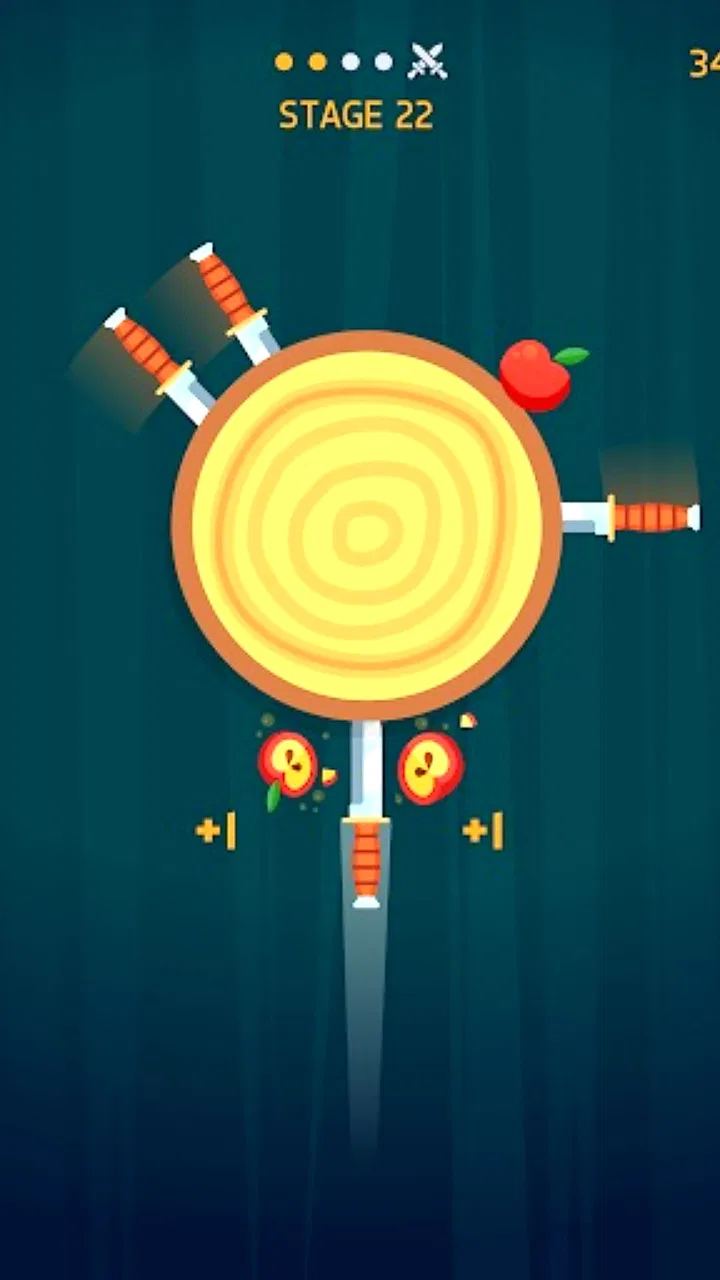
Knife Hit is the kind of arcade game I open when I want a quick challenge rather than a long gaming session. Its central idea is easy to understand: throw knives at a rotating target, place them carefully, and avoid hitting knives that are already stuck in the surface. That simplicity is exactly what makes it approachable, but it also creates a game where small mistakes become increasingly frustrating. After spending time with it, I see it as a focused test of timing and patience, best suited to short breaks and players who enjoy repeating a challenge until their hands and eyes settle into a rhythm.
Developed by Ketchapp, the game sits firmly in the casual arcade space. It is free to download, carries an Everyone age rating, and runs on devices using Android 7.0 or later. The store summary presents the basic goal as perfecting timing and hitting targets, but the more useful question is whether that narrow loop can hold your attention. In my experience, it can, especially when I am trying to beat a personal best, though it is not designed to replace a deeper action game or a story-driven experience.
How the knife-throwing loop feels in everyday play
The first few attempts are immediately readable. A target turns on screen, knives are available to throw, and each tap sends one toward the surface. The challenge comes from choosing the right moment. A gap that looks generous while the target is moving can disappear by the time the next knife reaches it, so random tapping rarely works for long. I found myself watching the rotation first, then tapping with a deliberate pause rather than reacting to the target at the last second.
You May Also Like

 Pandora - Music & Podcasts
Pandora’s Music Is Easy to Start, but Harder to Recover
Pandora’s strength is its low-effort path from a seed to a station. Its weak spot is how much confidence it asks you to place in connection, setup, and quiet recovery.

 AccuWeather: Weather Radar
AccuWeather Review: A Quick, Clear Forecast for Everyday Decisions
For everyday plans, the best forecast is the one you can understand quickly. AccuWeather makes rain timing, radar, and local conditions easy to act on, with a few trade-offs.

 Hill Climb Racing
Why Hill Climb Racing Still Turns Crashes Into One More Run
A tiny car, a bumpy hill and one more upgrade: Hill Climb Racing keeps resurfacing because its simple chaos makes every near-miss feel personal.

 AliExpress - Shopping App
AliExpress Makes Global Shopping Feel Personal, but Shoppers Bear the Risk
AliExpress turns a global marketplace into a pocket-sized discovery engine. Its reach is useful, its shopping loop compelling, and its trade-offs easy to miss.

 Lords Mobile: Kingdom Wars
Lords Mobile Is a Kingdom-Building Routine, Not a Quick Match
A case-by-case verdict on the building, battles, device demands, and social commitments that make Lords Mobile rewarding for some players and exhausting for others.

 PDF Scanner app - TapScanner
TapScanner Makes Paperwork Easier to Capture, Check, and Share
TapScanner makes scanning with a phone feel less like a rescue operation and more like a dependable step in getting work done. Its capture tools are useful, though not flawless.
More From Our News Desk
View All News


That makes Knife Hit a game of controlled repetition. A successful attempt does not require complicated controls, but it does require attention. The best results come from learning to recognize the target's open spaces and keeping a steady tempo. When I rushed, I often created my own problem by placing knives too close together. When I slowed down too much, the changing position of the target made the next opening harder to judge. The sweet spot is a calm, consistent rhythm.
This is particularly useful in an everyday situation where I have only a few minutes to spare. I can play while waiting for a coffee, during a short commute break, or between tasks without needing to remember a story, manage a team, or rebuild a complicated setup. A failed round also feels easy to restart, which removes much of the commitment associated with larger mobile games. The drawback is that the same convenience can make the experience feel repetitive when I am in the mood for more variety.
The game rewards observation more than speed. One practical technique is to stop treating every gap as equally safe. I look at the position of the knives already embedded in the target and identify the widest usable opening before tapping. This sounds obvious, but it changes the experience: instead of throwing whenever a space briefly appears, I wait for a predictable section of the rotation. That approach is slower, yet it gives me more control and makes later attempts feel less like luck.
Another useful habit is to avoid tapping in a frantic burst. Even when several knives appear to fit, rapid inputs can make it difficult to judge whether the target has rotated enough for the next throw. I prefer to let each knife settle visually, then reassess the remaining space. This is one of the small details that separates a satisfying run from a careless one. The controls are simple, but the game still leaves room for a personal technique.
Why the simplicity works, and where it starts to wear thin
Knife Hit benefits from having one clear purpose. There is no need to learn a large control scheme, and the basic action is understandable almost immediately. That makes it friendly for people who do not usually play games, including someone who wants a low-pressure title to try for a few minutes. The Everyone rating also makes its presentation broadly accessible, although parents should still use their usual judgment about screen time and in-app purchases.
At the same time, the narrow design means the game depends heavily on your tolerance for repetition. If you enjoy chasing cleaner timing and improving through failed attempts, the loop has a pleasant “one more try” quality. If you need frequent changes in objectives, exploration, or character progression, the same loop may feel limited. I would not recommend it to someone looking for a substantial single-player campaign or a game that constantly introduces new systems.
Compared with endless runners, Knife Hit asks for less continuous movement and more precise pauses. An endless runner is often about reacting to obstacles while the scene moves forward; here, the target itself is the main source of pressure, and the player controls the timing of each throw. Compared with puzzle games, it offers less planning and more hand-eye coordination. That places it in a useful middle ground: more deliberate than a purely reflex-driven tap game, but much lighter than a strategy puzzle.
It also differs from larger arcade collections because its identity is concentrated around one action. That focus can be a strength when I want something immediately available, but it means I cannot switch to a different type of challenge within the same experience. Players who enjoy a broad selection of mini-games may get better value from a collection, while players who like polishing one skill may appreciate this more concentrated design.
Cost, purchases, and what “free” means here
The game is free to access, so I can try the core experience without paying an upfront purchase price. That is important for this particular type of arcade title: the main decision is not whether to buy before playing, but whether the basic loop remains enjoyable enough to justify keeping it installed. The listed in-app purchases range from $0.99 to $19.99 per item, so optional spending can vary considerably depending on what a player chooses.
I would approach those purchases as convenience or customization spending rather than as a reason to install the game. The free entry point already lets a new player judge whether the timing challenge suits them. If I were recommending it to a friend, I would suggest playing for a while before considering any purchase. That gives a clearer sense of whether the game is providing genuine entertainment or simply benefiting from the impulse to continue after a failed attempt.
The distinction matters because a free game can still become poor value if it encourages spending before the player understands the experience. In this case, my practical advice is simple: treat payment as optional, set a personal limit in advance, and do not spend merely to erase the irritation of losing a difficult round. The game works best when progress feels connected to improved timing, not when money becomes the automatic response to a mistake.
There is also a useful value question for different kinds of players. Someone who plays only occasionally may get plenty from the free access because short sessions are the main attraction. A dedicated arcade fan may spend much longer refining technique, but that player should be comfortable with a focused loop rather than expecting a broad package. Since the purchase range is clearly listed, the sensible approach is to evaluate the free experience first and view any later payment as a personal extra, not a requirement for understanding the game.
Small techniques that make attempts more consistent
My most reliable method is to use the target's rotation as a clock. Instead of staring only at the next gap, I watch how long it takes a particular knife to return to a familiar position. That gives me a better feel for when to throw and reduces the temptation to react to every tiny opening. It is especially helpful after a failed attempt because I can identify whether the problem was poor timing or simply choosing a space that was too narrow.
I also find it useful to separate recognition from action. First I locate a safe-looking gap; then I decide whether the target will rotate into a knife before the throw lands. That second check is easy to skip, yet it is often the difference between a clean placement and an immediate collision. The game may look like a tapping test, but successful play involves a short prediction rather than a purely instant reaction.
A third technique is to take a brief pause after a mistake instead of restarting automatically. When I lose because I was tapping too quickly, an immediate retry often reproduces the same error. Waiting a moment helps reset my rhythm and makes the next attempt more deliberate. This is a small workflow, but it turns repeated failures into useful feedback. I can ask whether I misread the rotation, crowded the target, or simply acted before I had a clear opening.
Players using a phone with a smaller screen may also want to hold it steadily with both hands during demanding sections. The game does not require complex gestures, but a slight movement at the wrong moment can make a carefully timed tap feel less controlled. I prefer a stable grip and a quiet setting when trying to improve a run. For casual play, that preparation is unnecessary; for high-focus attempts, it makes the experience more comfortable.
Who will enjoy it, and who should look elsewhere
I think Knife Hit is a good match for players who enjoy compact challenges, visible improvement, and arcade rules that can be understood without a tutorial-heavy introduction. It is especially suitable for people who like testing patience and timing rather than managing resources or exploring a large world. It can also work well as a shared quick challenge: one person can hand over the phone after a failed attempt, and everyone understands the objective immediately.
It is less suitable for players who dislike restarting, because failure is part of the structure rather than an occasional interruption. Anyone who wants a relaxed game with little pressure may find the repeated collision penalty irritating. Likewise, players searching for deep customization, a narrative, or a wide range of activities should choose a different arcade or action title. Knife Hit is not trying to be an all-purpose mobile game, and its value drops sharply if its central timing loop does not appeal to you.
The audience size suggests that the format has broad appeal: the game has an average rating of 4.2 from around 1.2 million ratings and has passed 100 million installs. Those figures do not guarantee that every player will enjoy it, but they do show that the simple concept has connected with a substantial mobile audience. I see that popularity as consistent with the game's accessibility rather than evidence that it offers the depth of a premium console-style release.
The title has been available since January 20, 2018, and the current version is 1.8.30. For someone deciding whether it is worth trying now, the important point is that it is an established arcade game rather than a brand-new experiment. I would still judge it by the feel of the current version on the individual device, but its long presence and large player base make it a familiar option for this kind of quick-play experience.
My verdict after weighing the actual value
For me, the strongest reason to try Knife Hit is its low commitment. I can start a round quickly, understand what went wrong, and try again without investing in a long session. The free access makes that experiment easy, while the Everyone rating and Android 7.0 minimum requirement make it suitable for a broad range of players using compatible devices. Ketchapp keeps the idea focused, and that focus is both the game's main strength and its clearest limitation.
I would recommend it to a friend who likes short arcade tests and does not mind repeating a challenge to improve timing. I would not recommend spending immediately, because the free version is the right place to decide whether the loop has enough staying power. The optional purchases, ranging from $0.99 to $19.99 per item, should be treated cautiously and only considered after the game has already proved entertaining without them.
My buy-or-skip verdict: try it free, keep it if the timing loop makes you want another attempt, and skip it if repetition feels like work. It is not a substitute for a richer action game, but it does not need to be. As a compact arcade challenge, Knife Hit succeeds when you want a clear target, a few spare minutes, and a reason to slow down before tapping.
FAQs for Knife Hit
01What is Knife Hit and how does it work?
Knife Hit is a mobile arcade game where players throw knives at a rotating log, aiming to embed them without hitting any other knives. The objective is to break the log by hitting it with a set number of knives. As players progress, levels become more challenging, requiring precision and timing.
02Is Knife Hit free to play, and are there any in-app purchases?
Knife Hit is free to download and play, but it includes in-app purchases. These purchases can enhance gameplay by providing additional knives, removing ads, or unlocking special features. Players can enjoy the game without spending money, though optional purchases may enhance the experience.
03What are the main features of Knife Hit?
Knife Hit features a simple yet addictive gameplay mechanic where players test their reflexes and timing. It includes various levels with increasing difficulty, boss challenges, and a variety of knives to unlock. The game also offers a competitive edge with leaderboards, allowing players to compare scores globally.
04Does Knife Hit require an internet connection to play?
Knife Hit can be played offline, making it a great choice for gaming on the go. However, an internet connection is required for certain features, such as accessing leaderboards, syncing purchases, and receiving updates. Playing offline will limit these functionalities.
05Are there any ads in Knife Hit, and can they be removed?
Yes, Knife Hit contains ads which can appear between levels or as optional video ads for rewards. Players can choose to remove these ads by making an in-app purchase, providing an uninterrupted gaming experience. This option is ideal for those who prefer a seamless playthrough.
Pros
- Simple
- addictive gameplay mechanics.
- Variety of knife designs to unlock.
- Increasingly challenging levels.
- Smooth and responsive controls.
- Offline play available.
Cons
- Ads can be frequent and disruptive.
- Repetitive soundtrack can be annoying.
- Limited game modes available.
- In-app purchases for progression.
- Occasional lag on older devices.

Knife Hit
Gallery